
Abstract — Inadequate coverage for mobile telecommunications network operators in propagation environments remains a significant challenge. This challenge is more pronounced in densely populated cities due to complex building structures and facilities. Electromagnetic waves face considerable difficulties in propagating in such environments, resulting in significant losses. As a result, radio communication in these spots becomes uncontrollable, leaving network operators unaware of the communication processes in these locations. To address this challenge, various solutions have been proposed, with one such solution being the use of transmit-array/reflect-array antennas, which has recently attracted researchers’ attention.
Index Terms— Mobile signal coverage, 5G and 6G telecommunications generations, In-Building Solutions (IBS), Transmit-Array/Reflect-Array Antennas.
I. INTRODUCTION
Using transmit-array/reflect-array antennas can create a passive intelligent environment that ensures signal coverage in blind spots within buildings or even in other venues. This approach can be utilized in In-Building Solutions (IBS), particularly in the 5G telecommunications generation, where high-frequency operations prevail. As these antennas are primarily considered passive, they can be a highly suitable option concerning human health and safety. Moreover, they do not interfere with other operators’ frequency bands, eliminating concerns about increasing Received Total Wide Band Power (RTWP) from the Base Transceiver Station (BTS).
II. Transmit-Array Antenna in 5G and 6G IBS Applications
In 1986, McGrath introduced the microwave lens structure for the first time. In this article, a simple structure consisting of two connected printed antennas via a conductive interface was presented. This structure emphasized the ability to focus and scan. Consequently, a new concept named “transmit-array antenna” drew researchers’ attention. This structure is typically comprised of multiple intensifying elements called unit cells, placed alternately. Circuit printing technology is commonly used to implement transmit-array antennas. Therefore, besides being simpler to implement, it also allows for integration with other components, enabling these structures to easily adapt to Surface Mount Technology (SMT) for reducing the final structure’s dimensions. Since the feeding of these antennas is separate from the array part, conventional antennas can be used for applications requiring Beam Steering. The design of transmit-array elements is such that to create the desired Beamforming, the phase of each element must be adjustable. Thus, individual unit cells should have approximately 360-degree phase displacement capability. Each unit cell within a layer, regardless of the shape used, can generate up to 90 degrees of phase displacement within its 3 dB bandwidth.
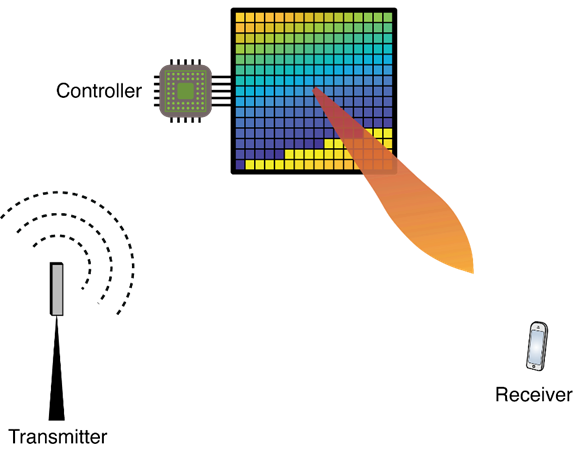
In this regard, by placing several layers alongside each other, the phase range can be increased. As mentioned, this method is referred to as cascaded amplifiers. Transmit-array antennas have also been implemented using other methods such as beamforming. In these structures, the first and last layers usually play the role of antennas, where the first layer is responsible for receiving waves and the last layer retransmits the waves back into the environment. The intermediary layers in this structure facilitate phase alteration, the possibility of radiation pattern rotation, and even the implementation of a filter. In the first method, waves are transmitted between microstrip layers through a slot, while in the second method, by routing through a slot to a transmission line and then directing it to the last layer, this process occurs. Design methods of transmit-array antennas are divided into these two broad categories, each with specific strengths and weaknesses, tailored to the intended application.
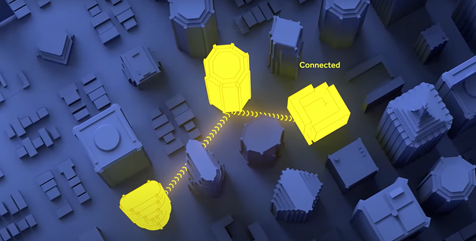
Circularly polarized antennas enable the transmission of information in two polarizations: either V or H polarization, so that if one component suffers losses, the signal information remains intact in the other polarization (H or V). This issue can be particularly crucial within residential environments, where building materials like walls, columns, etc., might cause wave losses in either the H or V component. Consequently, user connectivity in Downlink and UpLink paths to the BTS might be disrupted. Hence, the design and construction of transmit-array antennas with the capability to convert linear polarization to circular polarization can be a suitable option. This design allows the reception of linearly polarized waves from the BTS and their transmission within the building using circular polarization. Recently, this type of telecommunication antenna with rotation features, beam shaping, and high gain has garnered attention from researchers. Considering the challenges in cellular communications, especially concerning indoor solutions, these antennas could ensure signal coverage within buildings and blind spots.
III. Conclusion
Given the challenges associated with providing telecommunication signal coverage, including voice and data, within buildings and blind spots, diverse solutions called “In-Building Solutions” have been proposed to address this issue. The primary challenge with these solutions is their high setup cost, meaning the cost-to-subscriber ratio in the coverage area is notably high. Consequently, network operators face challenges, sometimes prompting subscribers themselves to set up such systems.
Due to the higher frequencies in 5G telecommunication generations, designing array antennas in optimized dimensions and weight becomes feasible, ensuring the desired frequency bandwidth required by network operators with high gain.
To set up an array antenna, initially, it needs to be placed in a location within the building that has adequate signal reception. Subsequently, the signal is transmitted from the BTS antenna to the transmit-array antenna and vice versa (UL, DL). In the next step, electromagnetic waves can be directed towards blind spots inside the building.
References
- Mei P, Pedersen GF, Zhang S. A broadband and FSS-based transmitarray antenna for 5G millimeter-wave applications. IEEE Antennas and Wireless Propagation Letters. 2020 Dec 3;20(1):103-7.
- Song C, Pan L, Jiao Y, Jia J. A high-performance transmitarray antenna with thin metasurface for 5G communication based on PSO (particle swarm optimization). Sensors. 2020 Jan;20(16):4460.
- Matos SA, Teixeira JP, Costa JR, Fernandes CA, Nachabe N, Luxey C, Titz D, Gianesello F, Del Rio C, Arboleya A, Garnero JP. 3-D-Printed Transmit-Array Antenna for Broadband Backhaul 5G Links at V-Band. IEEE Antennas and Wireless Propagation Letters. 2020 Apr 6;19(6):977-81.
- Prather DW, Shi S, Schneider GJ, Yao P, Schuetz C, Murakowski J, Deroba JC, Wang F, Konkol MR, Ross DD. Optically upconverted, spatially coherent phased-array-antenna feed networks for beam-space MIMO in 5G cellular communications. IEEE Transactions on Antennas and Propagation. 2017 Aug 3;65(12):6432-43.
- D. McGrath, “Planar Three-Dimensional Constrained Lenses,” IEEE Transactions on Antennas and Propagation, vol. 34, no. 1, pp. 46–50, Jan 1986.
- Reconfigurable Reflecting Surfaces for 5G/6G | University of Surrey – YouTube